Why Frontstack Became Frontic
We renamed the product from Frontstack to Frontic. Same mission - making tailored storefronts easier to build - but redesigned for the agentic era.
We renamed the product from Frontstack to Frontic. Same mission - making tailored storefronts easier to build - but redesigned for the agentic era.
When I stepped out of my role as CPO at Shopware in 2023, I had one goal: build something that solves a problem I'd seen for twenty years across agencies, enterprise teams, and platform companies.
Building truly tailored storefronts is still painfully hard - even though today's frontend stacks have never been more powerful and engineering teams solve far harder problems every day. A product grid, filters, a checkout flow. This isn't rocket science. And yet: it still takes months. Still costs six figures. Still requires an army of specialists.
The complexity isn't in the frontend. It's in everything the frontend has to connect to. Unique shopping experiences require coordinating APIs, business logic, content, and experimentation across systems that were never designed to work together.
The moment you leave the greenfield and enter the brownfield - the world of existing systems, individual processes, and bespoke requirements - everything slows down.
So we built Frontstack. An API backend purpose-built for storefronts - one that adapts in real-time and frees frontends from the constraints of legacy stacks. A layer that lets developers focus on experience and conversion instead of workarounds and integration headaches.
We validated the approach with lighthouse customers. The stack handled enterprise-grade requirements. We were ready to go to market. But instead of launching with full force, we paused - because something bigger was happening.
The way frontends are created is shifting. Suddenly, you can describe experiences instead of building them line by line. Natural language interfaces aren't a gimmick anymore - they're becoming the primary way software gets made.
We realized our original approach was right, but not far enough. The stack we'd built wasn't just useful for developers. It was exactly what AI models need to build production-quality storefronts: real schemas, real content, real business logic - not guesses, mocks, or assumptions.
That realization became Frontic.
The name says it: FRONT + (AGENT)IC. The same mission we started with - making it easier to build great storefronts - but designed for the agentic era.
Frontstack was a platform for developers. Frontic is a platform where AI and humans build together.
Here's what that means in practice:
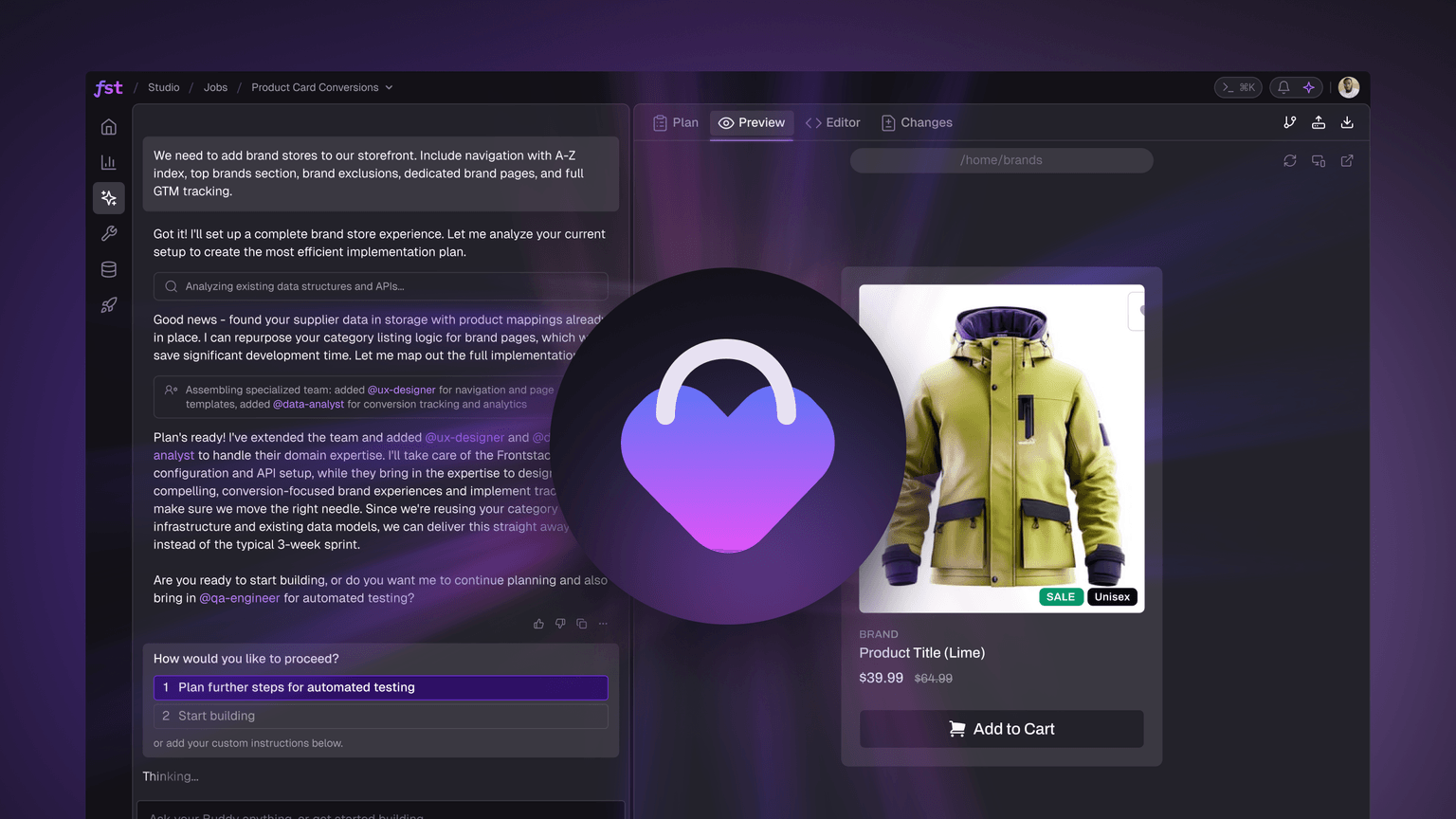
With Frontic Studio, you describe what you need in natural language. The system doesn't just generate code snippets - it acts on your behalf. It creates endpoints, configures data structures, sets up blocks, and wires everything together. Tell it "I need a product listing with color filters and sort by price," and you get a fully fledged component, not a code sample to copy-paste.
Frontic Studio is available now. You can sign up for free and start building. Early customers like xspo.com created dedicated brand experiences for their storefront in just a few hours - without writing code. For Tamaris, we're handling millions of datasets in production.
We believe the next generation of storefronts won't be assembled manually. They'll be orchestrated - by AI-powered agents that understand context, data, and intent.
The businesses that figure this out first won't just move faster. They'll operate in a different league entirely. What takes agencies months, AI does in hours. What took a team of specialists now takes a product manager with the right tools.
We're not building another AI wrapper. We're building the infrastructure that makes AI actually useful for commerce - connected to real backends, real data, real business logic.
That's Frontic. And we're just getting started.
Josh Seiler
Founder, Frontic
Be first in line for product updates and notes from the team.
Unsubscribe any time, one click.